
Embracing Market Dynamics: Navigating from Regime 4 to a Bullish Regime 3 and Beyond
We examine the shift from the challenging Regime 4 to the more bullish Regimes 3 and 2 in the financial markets.
OriginH
1/24/20242 min read
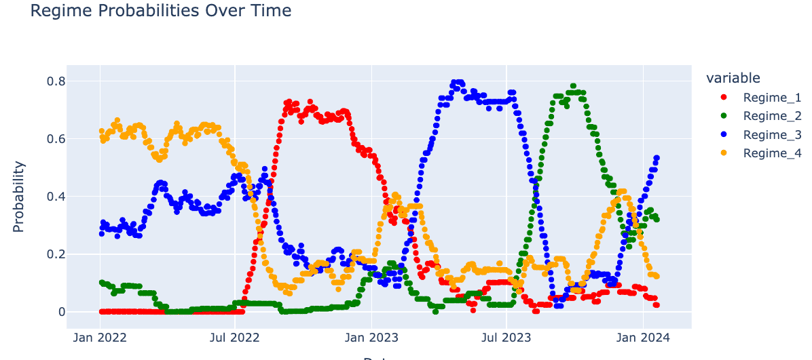
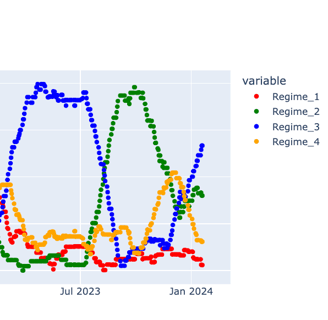
In line with our previous insights, the transient Regime 4 with its poor risk-adjusted returns has indeed passed, confirming our anticipation of its brevity. We have now entered the more favorable Regime 3, and are observing an upswing in Regime 2's prospects, heralding a period of growth and optimism as our machine learning models suggest. Next, we'll explore the defining features of Regime 3 and the resulting investment opportunities.
Transitioning to Bullish Regimes: A Bullish Outlook
Regime 3 has been characterized by:
A Sharp ratio of 1 for equities, indicative of favorable risk-adjusted returns
Generally positive returns across a broad spectrum of assets
This regime is indicative of bullish market conditions and suggests that growth-oriented strategies may be well-suited to the current environment.
Our analysis reveals that Regime 2 is on the ascent, which is particularly significant given its Sharpe ratio exceeding 2.5. This suggests an even more bullish scenario with superior risk-adjusted returns than those found in Regime 3. Regime 2 has remarkably low volatility with annualized returns greater than 20% across equities. Investors might consider the following approaches in the context of Regimes 3 and 2:
Maximizing Returns in Bullish Markets:
In the midst of a bullish regime, investors have the opportunity to leverage this momentum by increasing allocations to growth stocks or sectors with robust fundamentals, well-positioned to benefit from current economic conditions. Furthermore, as we look towards the potential shift to the even more bullish Regime 2, opportunities emerge particularly for growth-oriented and energy investments. In such a scenario, momentum factors typically outshine, whereas contrarian approaches that focus on market reversals often fall short. Our upcoming detailed analysis will further explore asset performance and the effectiveness of various factors in this promising regime.
Effective Risk Management in Bullish Markets:
In bullish markets, while pursuing higher returns with high-beta assets, investors must not lose sight of risk management and their personal risk tolerance. Diversification is essential – spreading investments across various asset classes and regions helps mitigate volatility. Additionally, incorporating assets that perform well during market disruptions or have low correlation with the market is crucial. These can serve as stabilizers, balancing the portfolio against potential external shocks and ensuring a more resilient investment strategy.
Conclusion:
The move into Regime 3 marks a promising turn in the market, further buoyed by the ascending likelihood of Regime 2. By recognizing and adapting to these regime shifts, we can strategically align our portfolios not just to withstand but to prosper amid these conditions. Our machine learning regime detection model plays a pivotal role in uncovering hidden market states, providing a sophisticated edge in our investment approach. Maintain equilibrium: seize the bullish market's offerings while vigilantly managing risks. For more insights subscribe below and follow us on twitter @orignholdings1.